In every culture. In every era.
An ancestral technology of regulation, healing and human encounter. Today, that wisdom meets contemporary science and practice. It is not a belief. It is an experience. A simple tool for tuning the way we live.
Tibetans with crystal bowls. Greeks with string instruments. Shamans with drums. African cultures with choral singing. Across the world and throughout history, sound was used as a tool for regulation, ritual and healing. It was not magic. It was knowledge of the body.
Sound waves directly influence the autonomic nervous system, alter brain waves and regulate emotional state. What traditions practised by intuition, neuroscience now measures and documents. Both sides speak of the same thing.
Frequency, resonance and presence are the elements that make sound a tool for real transformation.
Different frequencies produce different effects on the body and brain. Some induce calm. Others, focus. Others, release.
Every cell, organ and system has its natural frequency. When external sound resonates with the body, balance is created. It is physics. It is biology. It is experience.
Music medicine requires presence. Not effort — presence. That conscious openness activates transformation. The rest happens on its own.
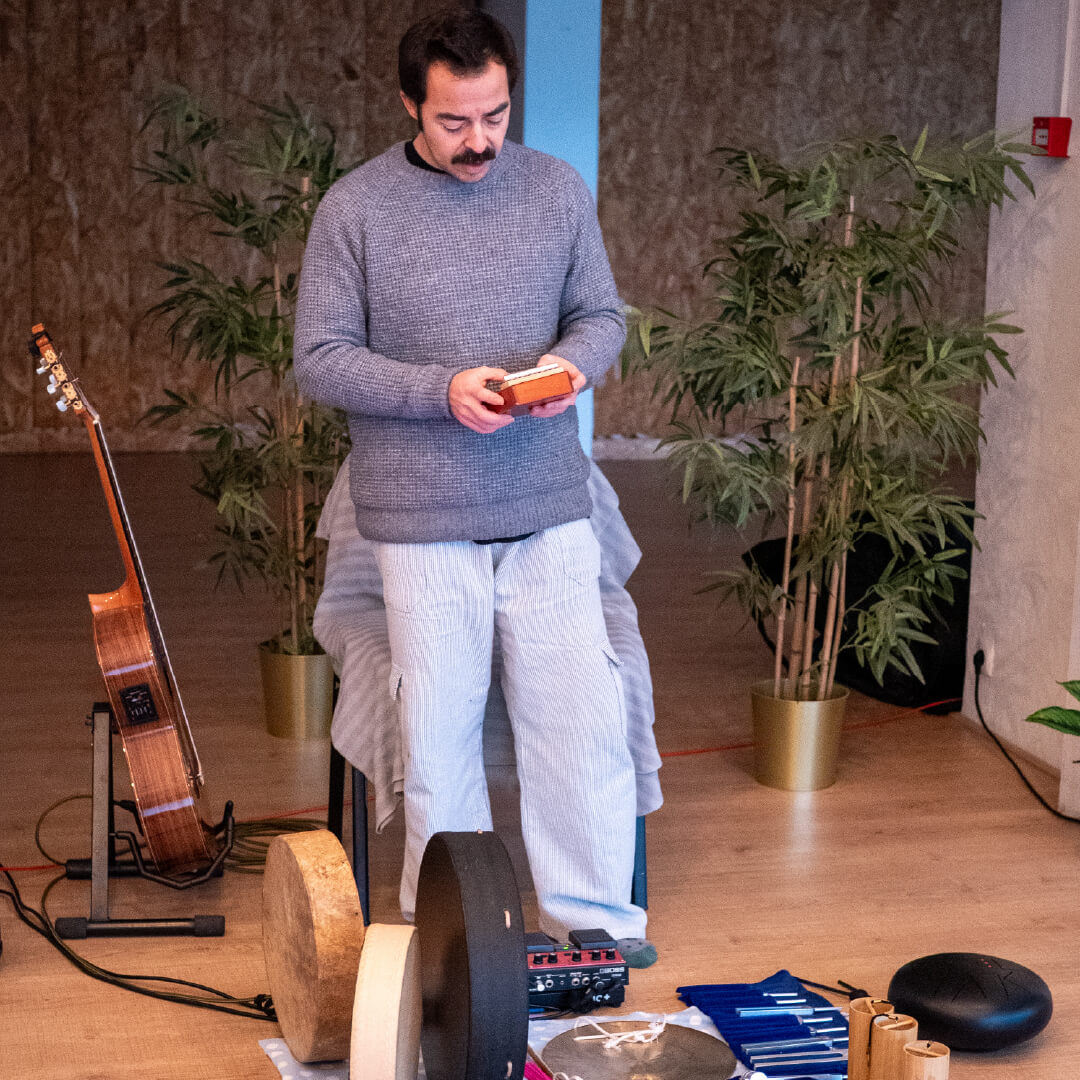
This is not a metaphor — it is a phenomenon studied in neuroscience, psychophysiology and sensory perception research.
The most observed outcome is a tendency for the system to move from stress states into regulation states.
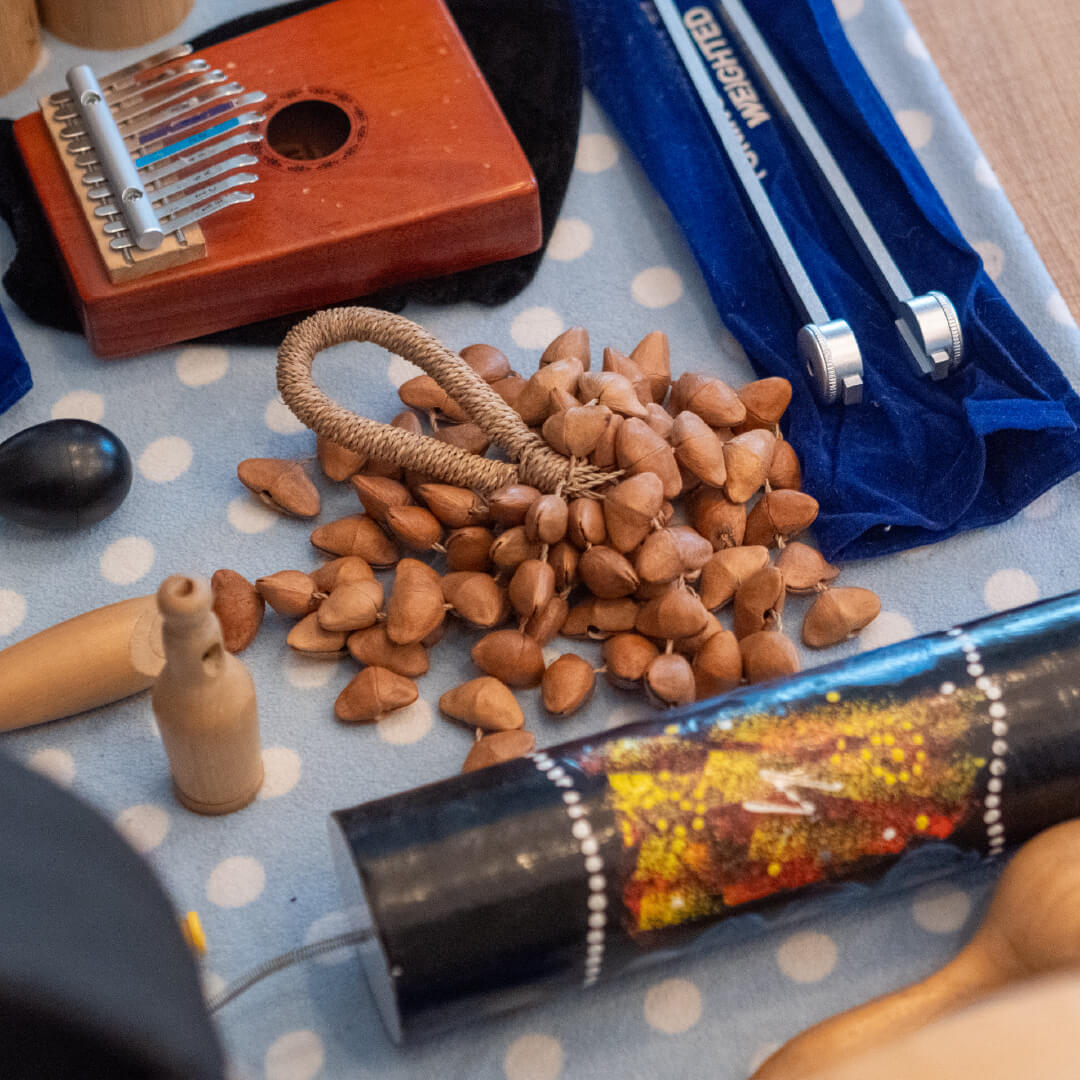
Studies in sound neuroscience, music therapy and bioacoustics show that structured sound stimuli can:

Sound is a form of mechanical energy the body interprets through:
The brain does not "just hear sound" — it organises meaning, predictability and safety from it. When the system recognises repetitive, harmonic or predictable patterns, it tends to reduce alert states.
Does not replace medical care. Works as a therapeutic complement.
Sound Healing is a practice that uses sound, frequency and vibration to influence the state of the body and mind. It is not about "healing" in the classical medical sense, but about creating internal conditions for the nervous system to slow down, the body to relax and consciousness to reorganise. It is a deep sensory experience where sound acts as a guide towards more subtle states of presence.
The body does not just "hear" sound — it feels vibration. When exposed to harmonic sounds, repetitive rhythms or sustained frequencies, the nervous system begins to synchronise with those patterns. This can lead to states of deep relaxation, reduced mental activity and greater bodily and emotional awareness. Simply put: sound helps the system move out of stress mode and into regeneration mode.
Both dimensions exist and need not exclude each other. On the scientific side, research in neuroscience, psychophysiology and brain wave studies shows how sound and rhythm influence the autonomic nervous system, attention and emotional states. On the spiritual and ancestral side, the use of sound as a tool for transformation has existed in ancient cultures for thousands of years. Modern Sound Healing lives precisely at that crossroads: experience + observation + presence.
It depends on what you mean by "work". It is not a mechanical technique with identical results for everyone. It is an experience that unfolds differently in each body, at each moment. What is consistent is this: many people report deep relaxation, emotional release, mental clarity and a sense of reconnection with themselves. The best way to understand is not to believe — it is to feel.
Yes, it is a non-invasive practice. It involves no substances, physical manipulation or medical intervention. What can happen is simply the body entering deeper emotional states — which can sometimes feel intense, but is natural within a safe, guided space.
No. There is no technique, performance or "right way" to be. The only thing needed is to allow yourself to be present — lying down, listening, feeling, without effort.
Yes. Before any session, it is important to share relevant health information — particularly epilepsy, heart conditions, pregnancy, active psychiatric disorders, use of medication affecting the central nervous system, or any other diagnosis you consider pertinent. This information is treated with complete confidentiality and is used solely to adapt the session in a safe and appropriate way. Sound Healing does not replace any ongoing medical treatment.
A living archive of research and references. Not a closed explanation — a space for continuous exploration.
Personal curation in areas such as:
A collection of content covering:
Sound Healing Demo
